Taekwondo 태권도Taekwondo Preschool
Promotion from one geup to the next can proceed rapidly in some schools, since schools often allow geup promotions every two, three, or four months. Students of geup rank learn the most basic techniques first, and then move on to more advanced techniques as they approach first dan. Many of the older and more traditional schools often take longer to allow students to test for higher ranks than newer, more contemporary schools, as they may not have the required testing intervals. View Taekwondo belt levels »

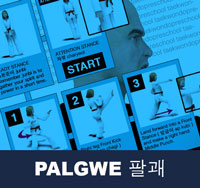
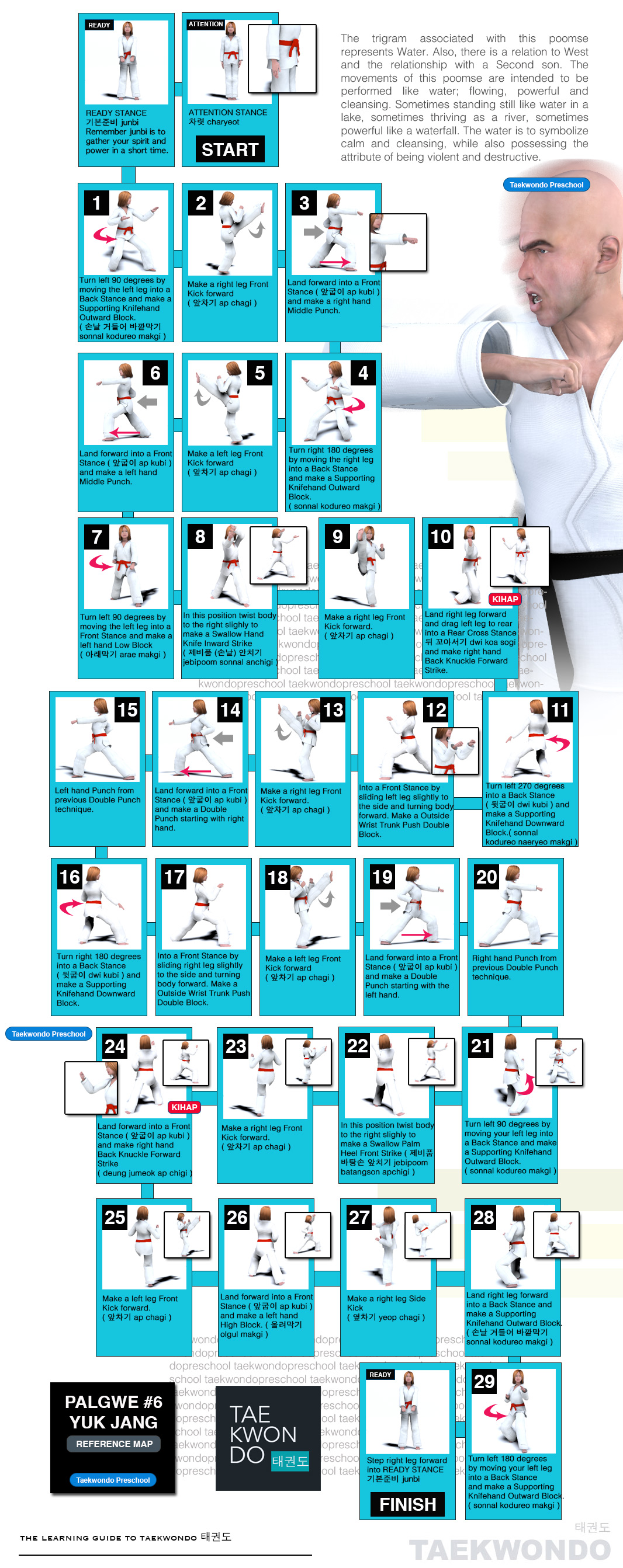
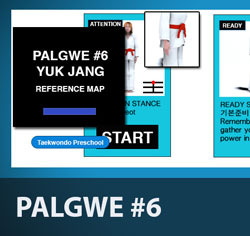
Palgwe #6 Yuk Jang
Poomse is the foundation for the teaching of Taekwondo. A poomse, or form, is a detailed pattern of defense-and-attack motions and techniques used in traditional martial arts. Poomse is useful in developing proper kinetics, mental and physical fortitude.
Palgwe 6 팔괘 6장 (Palgwe Yuk-jahng)
Meaning: Water
Movements: approx 27
Difficulty Level: Intermediate
Grade Level: 4th Geup
Ranking: Blue Belt 
Style: World Taekwondo (WT) 
The trigram associated with this poomse represents Water. Also, there is a relation to West and the relationship with a Second son. The movements of this poomse are intended to be performed like water; flowing, powerful and cleansing. Sometimes standing still like water in a lake, sometimes thriving as a river, sometimes powerful like a waterfall. The water is to symbolize calm and cleansing, while also possessing the attribute of being violent and destructive.
The Palgwe forms are a slightly older, somewhat similar supplemental group of World Taekwondo (WT) poomse. There are eight Palgwe forms that also represent eight trigrams from I-Ching. Palgwe poomse were used from 1967 to 1971. Taegeuk poomse have been in use from 1971 to the present time. Kukkiwon states that Palgwe poomse have been eliminated though some schools still teach them.
Training Methods
How well one improves with training depends on several factors, such as the frequency it is engaged in, and the type of feedback that is available for improvement. If a student does not train often enough, reinforcement fades, and he or she is likely to forget what was learned for the poomse.
When learning the poomse, it is helpful to use mirrors to observe your techniques and fix your mistakes immediately. Initially, a student may need focused feedback from a certified Master Instructor ( 사범님 sabeomnim ); however, as they progress, they must develop the ability to self-assess the poomse.
Difficulty of Poomse
Taekwondo students of geup ranking learn the most basic techniques first, and then move on to more advanced and difficult techniques as they approach 1st Dan Black Belt. The more difficult the techniques, the more practice may be needed for the purpose of improving or mastering it, as in the phrase 'practice makes perfect'. Every poomse must display the requisite speed, balance, power and firmness to be realistically used as an attack or defense move.
* Please see a certified Master Instructor ( 사범님 sabeomnim ) for training. Proper guidance and instructions are needed to ensure safe training.
Techniques Included in this Poomse
Both basic and advanced taekwondo techniques can be contained within a single pattern and the higher the level of the practitioner, the greater the difficulty of the techniques and the complexity of the pattern. Remember a poomse is a detailed pattern of defense-and-attack motions and techniques used in traditional martial arts. View more information Poomse »
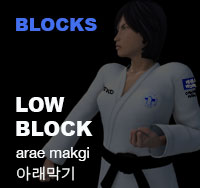
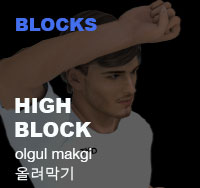
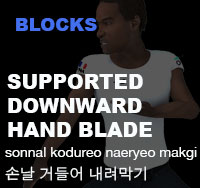
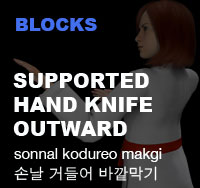
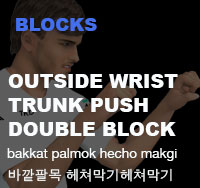
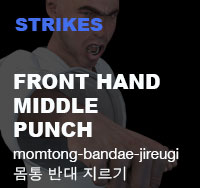

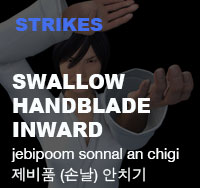
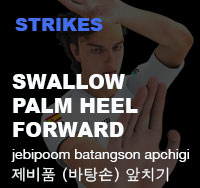
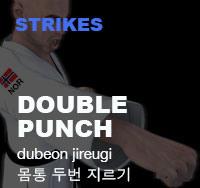
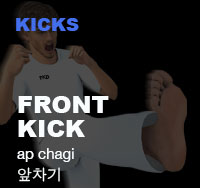
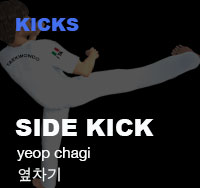
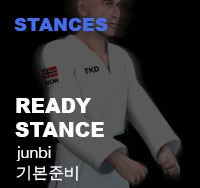
Palgwe 6 팔괘 6장 (Palgwe Yuk-jahng)
Key Points in this Poomse
- Accuracy. Patterns should begin and end in the same place.
- Posture. Practitioners must have their body weight correctly distributed during each different stance ( 서기 sogi ) and during footwork ( 딛기 ditgi ). Each technique must be correctly aligned.
- Realism. Taekwondo patterns are the learning ground for real combat. As such, every technique must display the requisite speed, power and firmness to be realistically used as an attack or defense move.
- Spirit. A competitor's 'presence' on the mat must be as credible as his/her technique. Self belief, confidence in abilities, and intention to perform to a personal best are tangible virtues considered indispensable in taekwondo practitioners.
- Decorum. Proper manners must be displayed when interacting with the judges directly before and after the pattern. Respect must also be extended to rival competitors, clubs and other officials.
- Form. General qualities that judges look for in any taekwondo practitioner include proper breathing technique and body control. The diaphragm must be engaged in deep breathing, shallow breathing concentrated in the upper abdomen results in raised shoulders and stressed muscles. The muscles of the body should be lightly relaxed in order to perform the pattern with fluidity, speed and grace. Muscles should only be tensed at the moment of imaginary impact in order to commute maximum power to any individual taekwondo technique.
Promotion Tests Requirement
Students often undergo periodic testing and grading by their own Master Instructor ( 사범님 sabeomnim ) in order to advance to a higher level of recognized achievement such as a different belt color. They need to demonstrate their proficiency in the various aspects of the art such as the execution of patterns ( 품새 poomse ), which combine various techniques in specific sequences.
Palgwe 6 팔괘 6장 (Palgwe Yuk-jahng) is a requirement for the below belt levels (Varies between schools). Promotion from one belt level to the next can proceed rapidly in some schools, since schools often allow geup promotions every two, three, or four months. Students of geup rank learn the most basic techniques first, and then move on to more advanced techniques as they approach first dan black belt. View Promotion Tests »
Use in Demonstrations
To promote taekwondo for its emphasis on high kicking and fast hand techniques, taekwondo schools perform at tournaments, community events, shopping malls, parks, and tv shows. Demonstrations vary from school to school, but may include such elements as the execution of poomse ( 품새 poomse ), which combine various techniques in specific sequences; the breaking of boards to demonstrate the ability to use techniques with both power and control; sparring ( 겨루기 gyeorugi ) and self-defense ( 호신술 hosinsool ) to demonstrate the practical application and control of techniques; physical fitness usually with push-ups and sit-ups. For more information on Demonstrations »
( Click image for additional information)
Advertisement

Did you know?
Taekwondo Pan American Games
The Pan American Games (also known colloquially as the Pan Am Games) constitute a major event in the Americas featuring summer and formerly winter sports, in which thousands of athletes participate in a variety of competitions including taekwondo. The competition is held between athletes from nations of the Americas, every four years in the year before the Summer Olympic Games. For more information View Taekwondo Pan American Games »
| Year | Date | Flag | City | Host Country |
| 2019 | July 26 - August 10 |  |
Lima | Peru |
| 2015 | July 19 - July 22 |  |
Toronto | Canada |
| 2011 | October 15 - October 18 |  |
Guadalajara | Mexico |
| 2007 | July 14 - July 17 |  |
Rio de Janeiro | Brazil |
| 2003 | August 13 - August 16 |  |
Santo Domingo | Dominican Republic |
| 1999 | July 23 - August 8 | |
Winnipeg | Canada |
| 1995 | July 23 - August 8 |  |
Mar Del Plata | Argentina |
| 1991 | August 3 - August 18 |  |
La Havana | Cuba |
| 1987 | August 14 - August 16 |  |
Indianapolis | USA |
RESOURCES
This article uses material from the Wikipedia article "Pan American Games" which is released under the Creative Commons Attribution-Share-Alike License 3.0.
Advertisement

Quiz
Question. In what year was the World Taekwondo Federation (WTF) officially established?
The World Taekwondo Federation is the International Federation [IF] governing the sport of Taekwondo and is a member of the Association of Summer Olympic International Federations [ASOIF]. The WTF was established at its inaugural meeting held at the Kukkiwon ( 국기원 ) with participation of 35 representatives from the world and until this day there is a total of 205 Member Nations. The World Taekwondo Federation (WTF) has renamed itself to World Taekwondo (WT) in 2017.
Question. In what year was the World Taekwondo Federation (WTF) officially established?
Answer you gave was: 1971
Your answer is wrong! You need to study more!
The World Taekwondo Federation (WTF) was established on May 28, 1973 (Renamed itself to World Taekwondo (WT) in 2017). According to the WTF, "Taekwondo is one of the most systematic and scientific Korean traditional martial arts, that teaches more than physical fighting skills. It is a discipline that shows ways of enhancing our spirit and life through training our body and mind". Today, it has become a global sport that has gained an international reputation, and stands among the official games in the Olympics.
Question. In what year was the World Taekwondo Federation (WTF) officially established?
Answer you gave was: 1973
Your answer is correct! Great Job!
The World Taekwondo Federation (WTF) was established on May 28, 1973 (Renamed itself to World Taekwondo (WT) in 2017). According to the WTF, "Taekwondo is one of the most systematic and scientific Korean traditional martial arts, that teaches more than physical fighting skills. It is a discipline that shows ways of enhancing our spirit and life through training our body and mind". Today, it has become a global sport that has gained an international reputation, and stands among the official games in the Olympics.
Question. In what year was the World Taekwondo Federation (WTF) officially established?
Answer you gave was: 1975
Your answer is wrong! You need to study more!
The World Taekwondo Federation (WTF) was established on May 28, 1973 (Renamed itself to World Taekwondo (WT) in 2017). According to the WTF, "Taekwondo is one of the most systematic and scientific Korean traditional martial arts, that teaches more than physical fighting skills. It is a discipline that shows ways of enhancing our spirit and life through training our body and mind". Today, it has become a global sport that has gained an international reputation, and stands among the official games in the Olympics.
Question. In what year was the World Taekwondo Federation (WTF) officially established?
Answer you gave was: 1977
Your answer is wrong! You need to study more!
The World Taekwondo Federation (WTF) was established on May 28, 1973 (Renamed itself to World Taekwondo (WT) in 2017). According to the WTF, "Taekwondo is one of the most systematic and scientific Korean traditional martial arts, that teaches more than physical fighting skills. It is a discipline that shows ways of enhancing our spirit and life through training our body and mind". Today, it has become a global sport that has gained an international reputation, and stands among the official games in the Olympics.
Question. What is the name of Taegeuk #3 in Korean?
Taegeuk 태극 (in World Taekwondo (WT)) refers to a set of poomse 품새 used to create a foundation for the teaching of taekwondo. A poomse or form is a detailed pattern of defense-and-attack motions and techniques used in traditional martial arts. Each taegeuk form symbolizes a specific state thought to be indicative of the belt the student currently holds, and is represented in World Taekwondo (WT) by trigrams similar to those found in the four corners of the South Korean flag.
Question. What is the name of Taegeuk #3 in Korean?
Answer you gave was: Chil Jang
Your answer is wrong! You need to study more!

The trigram associated with this poomse represents a Mountain. Also, it represents the northwest and youngest son. The symbolism behind the mountain is the indomitable and majestic nature that all mountains possess. This poomse is intended to be performed with the feeling that all movements are this majestic due to their unconquerable nature.
Question. What is the name of Taegeuk #3 in Korean?
Answer you gave was: Sam Jang
Your answer is correct! Great Job!
This trigram represents Fire. Related to this symbol is also East and the relationship of the Second Daughter. Fire contains a lot of energy. The symbol behind the fire is similar to the symbolism of the water in that both can aid and both can destroy. This form is intended to be performed rhythmically, with some outbursts of energy to reflect fire's rhythmic and energetic dualism.
Question. What is the name of Taegeuk #3 in Korean?
Answer you gave was: Yi Jang
Your answer is wrong! You need to study more!
The associated trigram of this poomse represents the Lake. Also, related to the symbol is South East and the relationship of the youngest daughter. The movements of this Taegeuk are aimed to be performed believing that man has limitations, but that we can overcome these limitations. The Lake and its water symbolize the flowing and calm nature of the martial artist.
Question. What is the name of Taegeuk #3 in Korean?
Answer you gave was: Sa Jang
Your answer is wrong! You need to study more!

This trigram represents Thunder. Also, the trigram is strongly connected to northeast and the relationship of the Eldest son. Thunder comes from the sky and is absorbed by the earth, thus, according to the beliefs of the I Ching, thunder is one of the most powerful natural forces. This poomse is associated with power and the connection between the heavens and earth.
Question. What is the korean terminology for Front Stance?
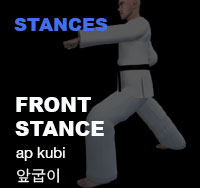
Front Stance is a precursor of the fighting stance ( 겨루기준비 gyeorugi-junbi ) according to some martial arts authors. Body should be relaxed in this stance ( 서기 sogi ) when performed in patterns ( 품새 poomse ) and self-defense ( 호신술 hosinsool ). Although the specifics of the stance vary by style, overall it is visually similar to a lunge, with the forward leg bent at the knee, and the rear leg straight, while the hips and shoulders remain squarely facing forward.
Question. What is the korean terminology for Front Stance?
Answer you gave was: ( 뒷굽이 dwi kubi )
Your answer is wrong! You need to study more!
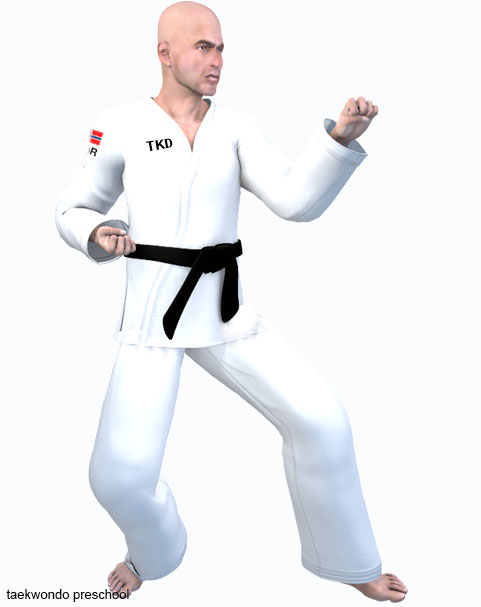
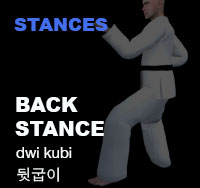
Back Stance ( 뒷굽이 dwi kubi ) is specifically focused on shifting weight to the back leg, as it offers much more control, and makes it easier to kick off the front leg. To perform the Back Stance ( 뒷굽이 dwi-kubi ), the body faces to the side, with the front foot facing forward and the front leg bent. The back leg is bent slightly and the foot is turned outwards perpendicular to the front foot making the letter "L" for this stance ( 서기 sogi ).
Question. What is the korean terminology for Front Stance?
Answer you gave was: ( 주춤서기 juchum sogi )
Your answer is wrong! You need to study more!
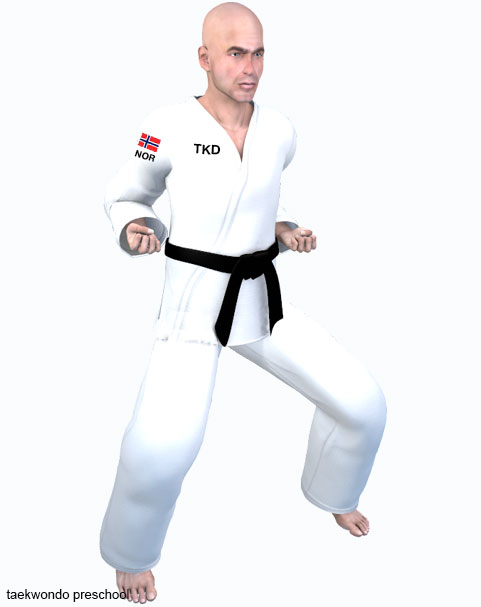
The Horse-Riding Stance ( 주춤서기 juchum-sogi ) is a beginner stance ( 서기 sogi ) generally used to practice punches ( 지르기 jireugi ) and blocks ( 막기 makgi ). It is similar to the Ready Stance ( 기본준비 junbi ) but the feet are placed much wider, about two-foot length's apart. Also, the knees ( 무릎 mureup ) are deeply bent and the shins ( 정강이 jeonggangi ) should be kept slightly perpendicular to the floor.
Question. What is the korean terminology for Front Stance?
Answer you gave was: ( 앞굽이 ap kubi )
Your answer is correct! Great Job!
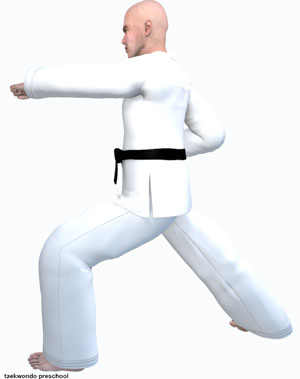
Front Stance ( 앞굽이 ap-kubi ) is one of the most important techniques to learn when starting taekwondo as a beginner. The distance between the inside edges or namely the Reverse Foot Blade ( 발날등 balnaldeung ) of both feet should be between one to two fists apart and is about 4 to 4 one-half foot-length from origin. Rear toes are turned outward about 30 degrees and the body is also naturally angled at 30 degrees or facing straight forward depending on the upper body technique.
Question. What is the korean terminology for Front Stance?
Answer you gave was: ( 앞서기 ap sogi )
Your answer is wrong! You need to study more!
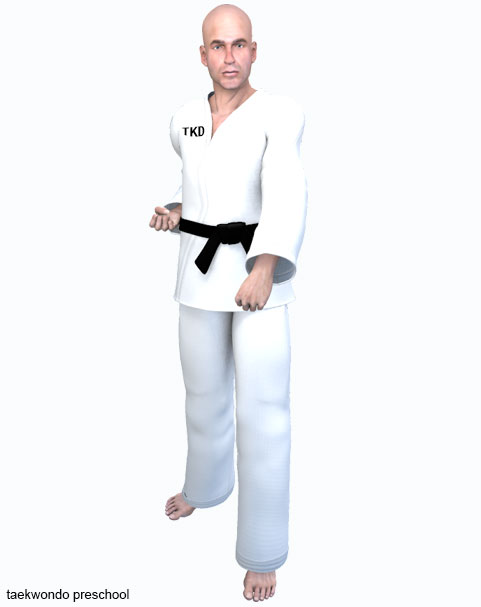
The Walking Stance ( 앞서기 ap-sogi ) is a beginner stance ( 서기 sogi ) that is used to approach or retreat in combat and patterns ( 품새 poomse ). Feet should be maintained approximately 3 foot-length from origin. To maintain a solid base, the front foot is facing straight forward and the back foot is 30 degrees to aid balance. Use of this stance ( 서기 sogi ) is featured prominently in many of the World Taekwondo (WT) Poomse.
About Palgwe 팔괘 Forms
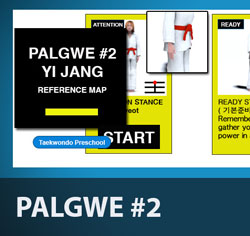
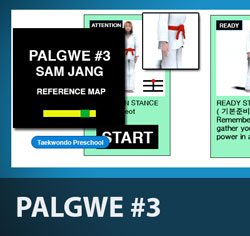
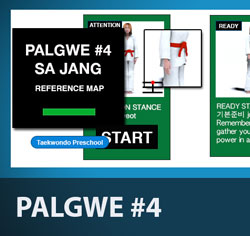
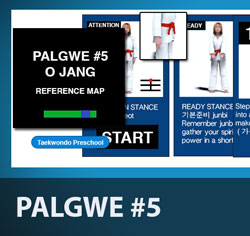
The Palgwe forms are a slightly older, somewhat similar supplemental group of World Taekwondo (WT) poomse. There are eight Palgwe forms that also represent eight trigrams from I-Ching. Palgwe poomse were used from 1967 to 1971. Taegeuk poomse have been in use from 1971 to the present time. Kukkiwon ( 국기원 ) states that Palgwe poomse have been eliminated though some schools still teach them. View more information about Palgwe Forms »
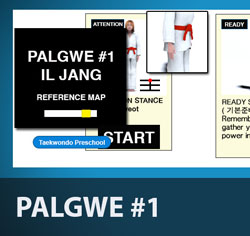
General qualities that judges look for in any taekwondo practitioner include proper breathing technique and body control. The diaphragm must be engaged in deep breathing, shallow breathing concentrated in the upper abdomen results in raised shoulders and stressed muscles. The muscles of the body should be lightly relaxed in order to perform the pattern with fluidity, speed and grace. Muscles should only be tensed at the moment of imaginary impact in order to commute maximum power to any individual taekwondo technique. For more information View Key Points »
RESOURCES
This article uses material from the Wikipedia articles "Taegeuk" and "Hyeong", which is released under the Creative Commons Attribution-Share-Alike License 3.0.